The Double-Edged Sword of Faith: How to Trust Without Losing Yourself
When life unravels, people will often say, “Just have faith.”
It may sound comforting—but if you’re the one trying to hold on, it’s maddening.
Faith is beautiful when things are going right. It’s easy to trust when prayers are answered, when timing feels divine, when doors open before you even knock. But what about when it’s quiet? When everything you hoped for seems delayed, or worse—denied?
What about when faith feels like waiting in a room shrouded in darkness with no sign that the light is going to turn on?
The Complicated Truth About Faith
Faith is supposed to anchor us—but sometimes, it can feel like a trap.
We tell ourselves we’re “trusting the process,” but deep down, we’re wondering if we’re just standing still. We repeat affirmations, quote verses, meditate, pray—but some days, the silence feels louder than the promises.
There’s a side of faith no one talks about—the exhaustion of believing in something that hasn’t shown up yet.
And maybe that’s the real test: faith isn’t about holding on when it’s easy; it’s about staying open when everything in you wants to shut down.
When Faith Becomes a Form of Waiting Instead of Living
At some point, many of us confuse faith with passivity. We think trusting means doing nothing.
We wait for signs, for clarity, for divine intervention—while our lives quietly sit on pause.
But faith was never meant to freeze you.
It was meant to free you.
The truth is, there’s a fine line between trusting and abandoning your own power.
Sometimes, we hand everything over to the universe, to God, to “fate,” because it’s easier than facing our fear of failure.
Real faith isn’t blind. It’s brave.
It doesn’t ignore your effort; it amplifies it.
The Pros of Trusting Faith
Let’s honor the beauty first—because faith does build something profound within us.
1. Faith builds resilience.
When you’ve walked through seasons that made no sense and still held your head high, you learn your strength isn’t circumstantial—it’s spiritual.
2. Faith gives hope structure.
It allows you to dream beyond what’s visible, to find meaning in the middle of mess. It’s the belief that even in chaos, there’s choreography.
3. Faith creates peace in uncertainty.
When you stop trying to control every outcome, your nervous system can breathe again. You realize that life unfolds in its own rhythm—and that rhythm doesn’t need your panic to play.
The Cons of Trusting Faith (That No One Likes to Admit)
Faith, though sacred, can also distort reality when misunderstood.
Let’s talk about it—without sugarcoating.
1. Faith can mask avoidance.
Sometimes we call it “waiting on God,” but really, we’re avoiding hard decisions.
We pray about things we already know the answer to, because taking action would mean accountability.
2. Faith can silence intuition.
If we outsource all authority to external signs, we forget the voice within us—the one God, or whatever you believe in, already placed inside.
Faith isn’t meant to replace intuition; it’s meant to deepen it.
3. Faith can delay healing.
When we’re taught to “trust and let go,” we may skip the deeper emotional work—grief, anger, disappointment—that’s required for real growth.
Faith is not denial. It’s the courage to feel everything and believe anyway.
The Middle Space: Where Faith Meets Agency
If faith is one wing, then action is the other. You need both to fly.
The women I’ve met—mothers, entrepreneurs, creators—often wrestle with this dance between trust and control. We’re told to surrender, but also to strive. To let go, but also to lead.
It’s confusing until you realize this:
Faith is not the opposite of effort. It’s the alignment of it.
It’s saying, “I’ll show up, even if I don’t see the full picture yet.”
It’s making the call, sending the email, applying for the job, taking the necessary action—without needing the guarantee of a perfect ending.
You move, and faith moves with you.
I’ve had seasons where I was waiting for life to “make sense.”
I prayed, I journaled, I waited for a sign—and I missed opportunities because I mistook stillness for surrender.
But my turning point came when I realized: Faith without movement becomes stagnation. It becomes the ruin of situations that ought to be handled.
It was only when I started taking steps—writing the book, starting the conversation, showing up for myself even when the outcome wasn’t clear—that doors began to open.
And maybe that’s the point. Faith grows not in stillness, but in motion.
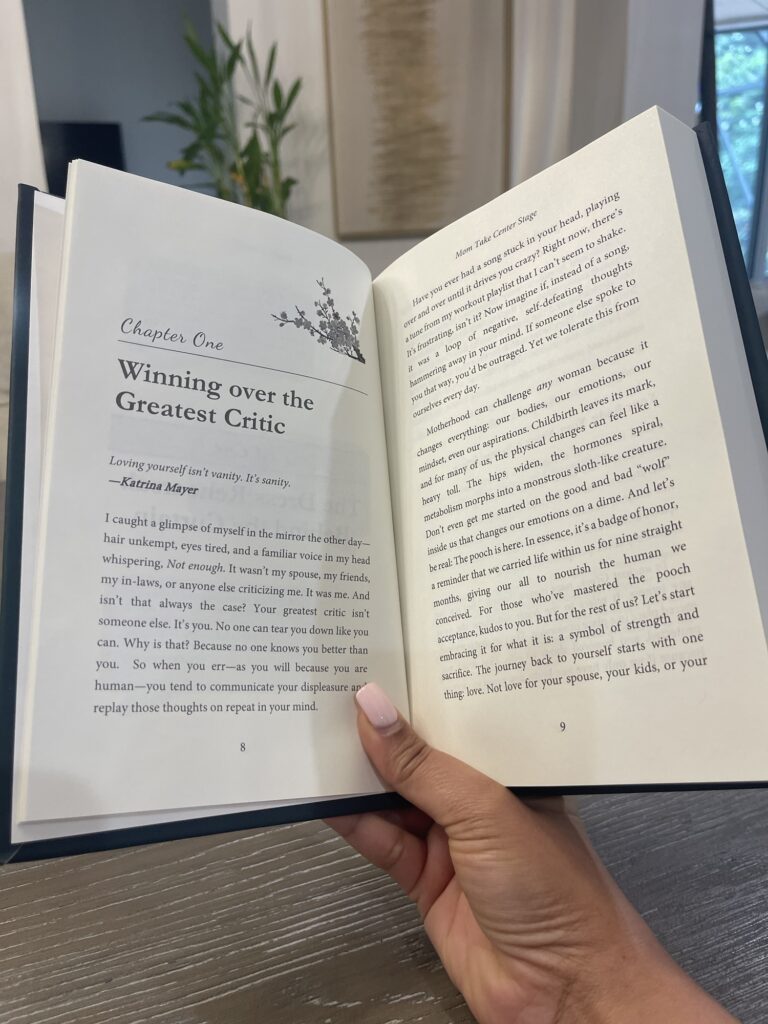
I wrote about this tension in my book, Mom Take Center Stage. So many mothers live in this quiet tug-of-war—hoping for a life that feels aligned, yet afraid to reclaim their power while they wait for permission from something or someone.
The truth is, you are the permission. You don’t need to ask or await it.
You can have faith and still take the next step. You can surrender without disappearing.
It’s supposed to make you certain—not in the outcome, but in yourself.
You don’t need to blindly trust everything will work out; you can trust that you’ll handle it when it doesn’t.
You don’t have to wait for a divine yes to start living; your courage is the yes.
Faith isn’t a substitute for action—it’s the energy that fuels it.
How to Practice Faith Without Losing Yourself
Redefine what “trust” means. Trust doesn’t mean no fear—it means fear isn’t your decision-maker. You can feel uncertain and still take action.
Balance prayer with participation. Pray for clarity, but also apply pressure. Faith doesn’t remove your responsibility—it partners with it. Listen inward as much as upward.
Don’t just wait for signs—tune into your own intuition. That inner voice is often where faith whispers loudest.
Detach from the timeline. Faith rarely unfolds in straight lines. Trust the process and allow detours.
Measure faith by peace, not outcomes. If your version of “trusting” leaves you anxious, you’re not in faith—you’re in fear of losing control.
Faith That Feels Like Freedom
Sometimes faith can feel rigid and rule-bound—and sometimes faith can feel like breathing.
The first demands perfection.
The second invites participation.
One silences your inner voice.
The other strengthens it.
You don’t need to choose between surrender and strength.
You were always meant to live in the balance of both.
Faith doesn’t always look graceful.
Sometimes it’s crying in the car before a big decision, praying for peace before sending the email, or saying “yes” while still shaking.
That’s real faith.
Not the kind that denies fear—but the kind that walks with it.
Because trusting faith doesn’t mean you’ll never fall. It means that even if you do, you’ll rise again—wiser, softer, stronger, and still willing to believe.
If this post spoke to your heart, my book, Mom Take Center Stage dives even deeper into this journey—how to rebuild trust in yourself, your timing, and your worth.
It’s a reminder that faith isn’t waiting for the light—it’s daring to shine while it’s still dark.